ENGINEERING CASE STUDY · IN PROGRESS
EMG-Controlled Prosthetic Robotic Hand
Transforming forearm muscle activity into reliable finger actuation through digital signal processing.
Engineering challenge
Raw surface EMG signals contain baseline drift, motion artifacts, electrical interference, and high-frequency noise. The project investigated an accessible way to extract dependable muscle-activation commands for prosthetic-hand control.
Prosthetic system
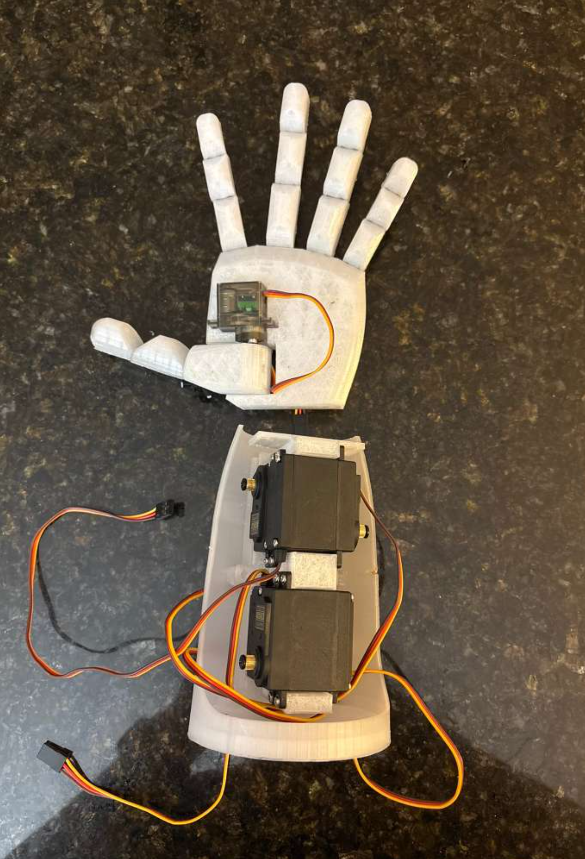
The PETG hand uses a tendon-driven mechanism with nylon paracord and five servomotors, allowing each finger to move independently. Surface electrodes capture forearm activity through an EMG sensor connected to an Arduino Uno for signal acquisition and servo control.
Signal-processing pipeline
Recorded EMG data were processed in MATLAB through DC-offset removal, moving-average filtering, full-wave rectification, RMS-envelope extraction, and adaptive threshold detection. The final output converts detected contractions into a binary activation signal.
Prototype result
The pipeline reduced noise and identified two dominant contraction events in the analyzed trial. Those detections were translated into mechanical finger movement, demonstrating a functional low-cost foundation for EMG-controlled prosthetics.
My role
I led project conceptualization, software development, and project administration, and contributed to methodology, investigation, formal analysis, visualization, and manuscript preparation.
Next development steps
The current prototype is limited by response delay, grip strength, electrode-placement sensitivity, and offline MATLAB analysis. Planned development includes real-time embedded processing, adaptive thresholds, and more robust classification across users.